この盤は AD LIBから発売された ADL-6601(通称ネコのマクリーン)と同じ演奏内容ですがJUBILEEレーベルからタイトルも変更して発売されたものです。
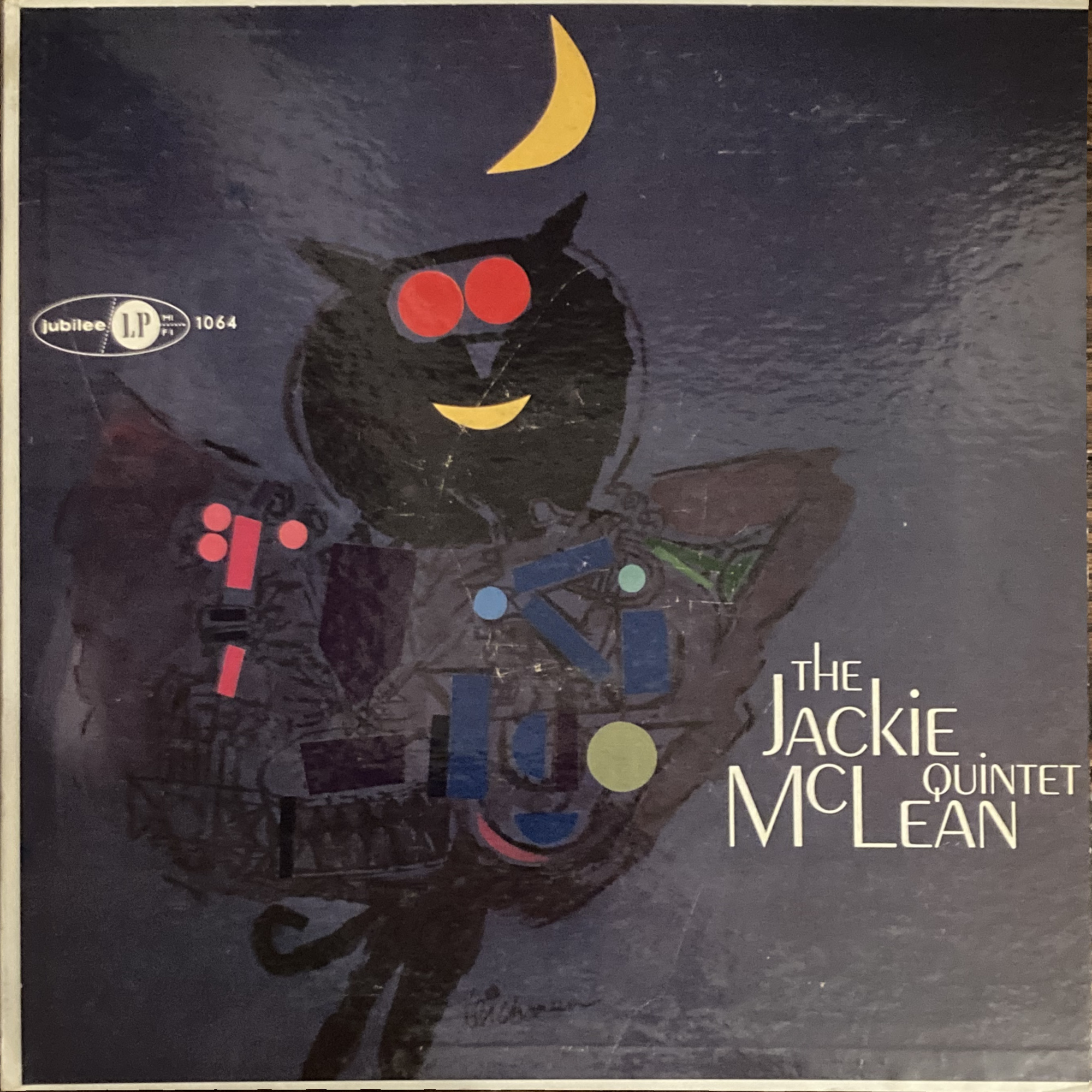
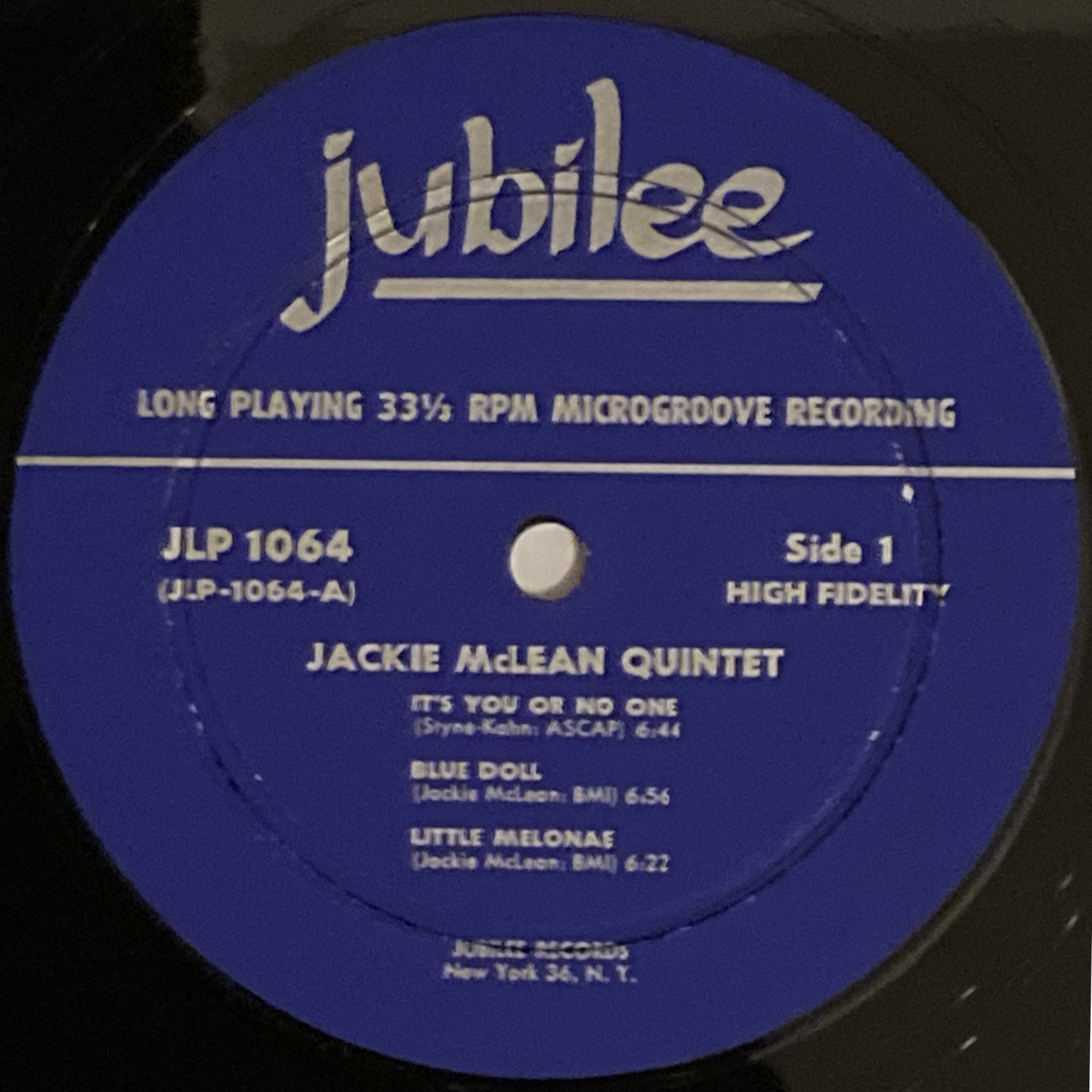
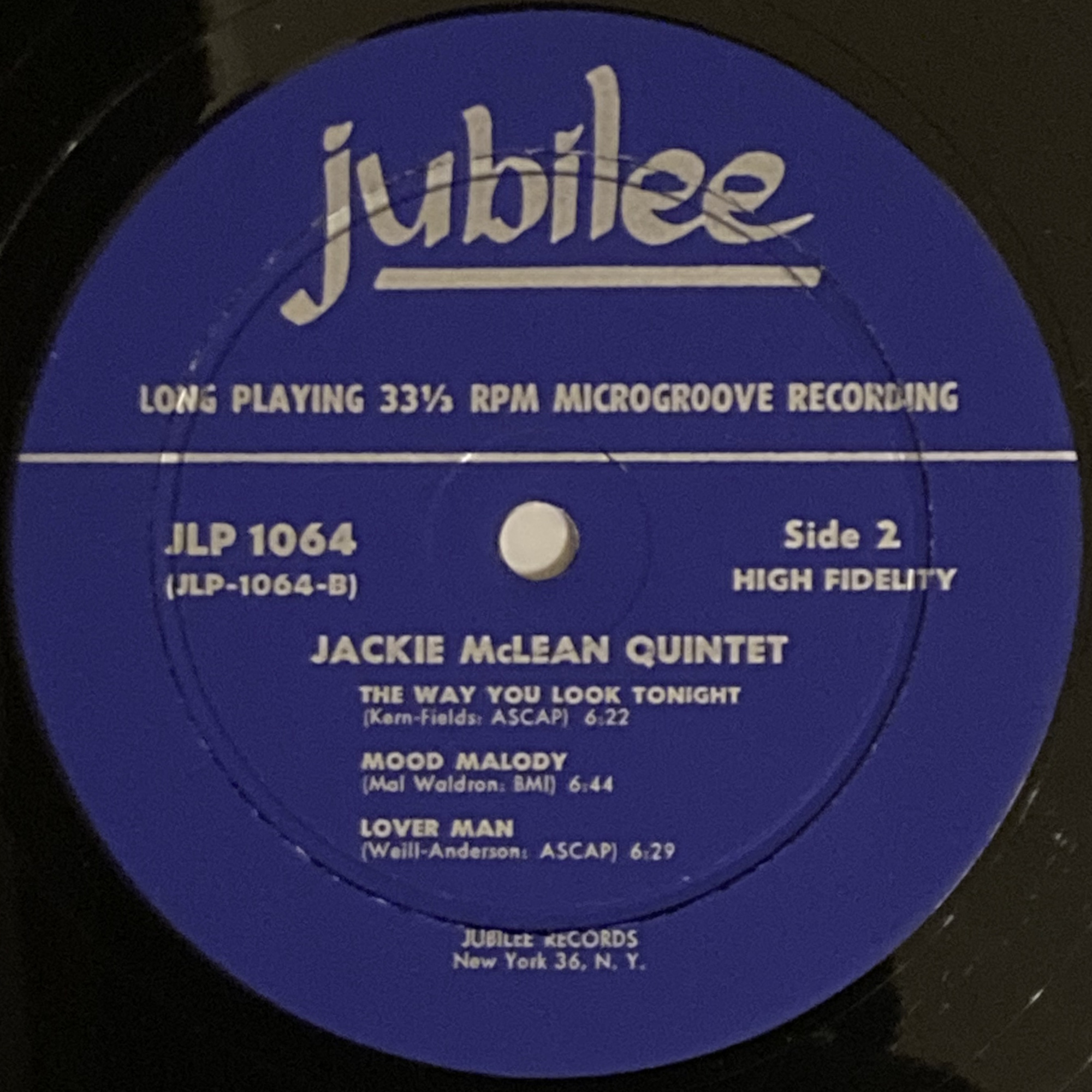
センターレーベルの写真はかなり初期の青色タイプですが、残念ながらRVGの刻印がありませんのでADLBをオリジナルとすると本番は3rd盤ということになります。(2ndは青色レーベルとRVG刻印)
Label: JUBILEE RECORDS
No.: JLP-1064
Title: THE Jackie McLean Quintet
Musician: Jackie McLean Quintet
Recorded: 1955/10/21
Monaural
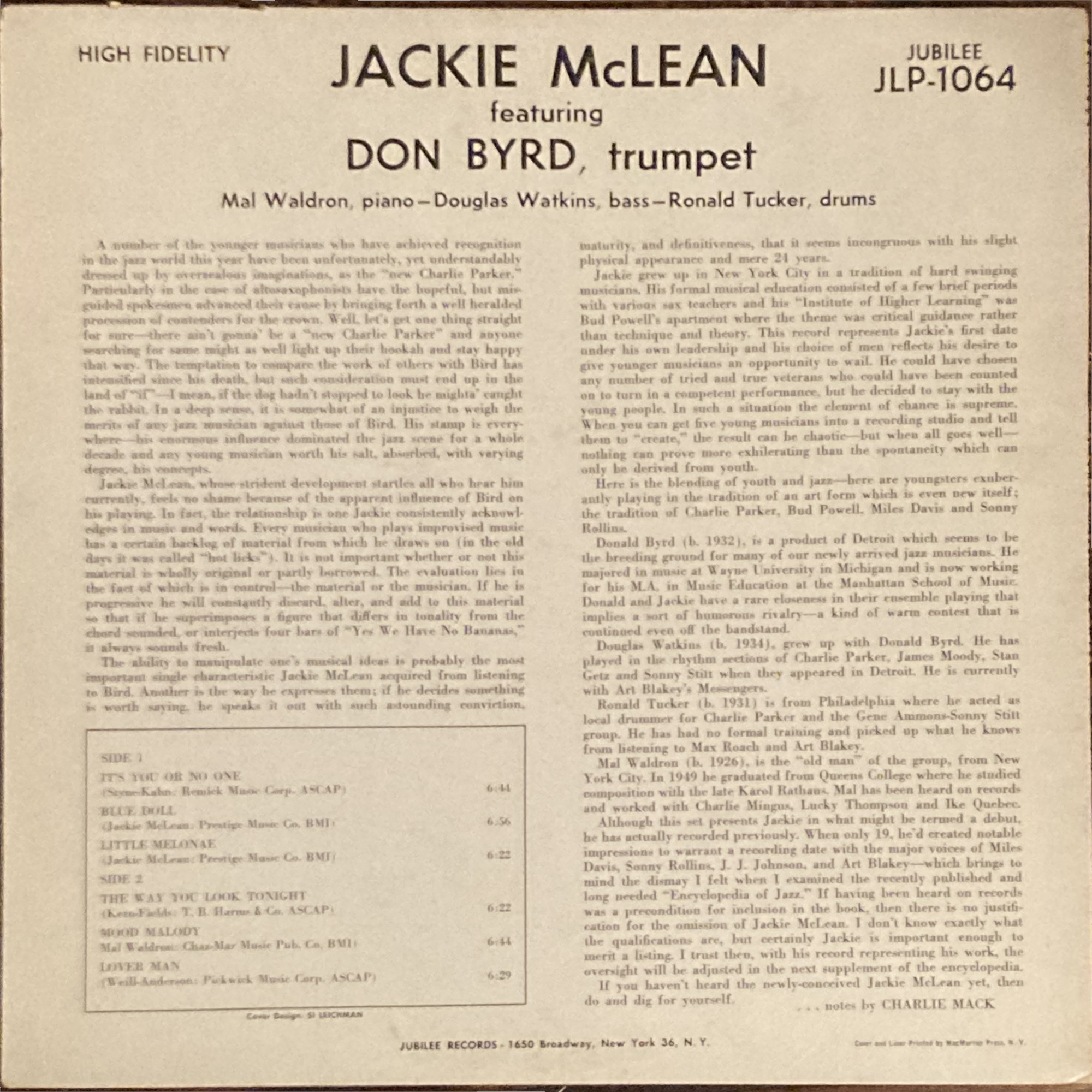
Cover address: 1650 Broadway, NEW YORK 36, N. Y.
Groove Guard
Label Side-A
Blue Background Silver Letter
Deep Groove
Engrave: JLP-1064-A
Label Side-B
Blue Background Silver Letter
Deep Groove
Engrave: JLP-1064-B
Personnel-
Drums: Ronald Tucker
Bass: Doug Watkins
Piano: Mal Waldron
Alto Sax: Jackie McLean
Trumpet: Donald Byrd
Tracks-
Side-A
1) It’s You or No One 6’44”
2) Blue Doll 6’56”
3) Little Melonae 6’22”
Side-B
1) The Way You Look Tonight 6’22”
2) Mood Malody 6’44”
3) Lover Man 6’29”
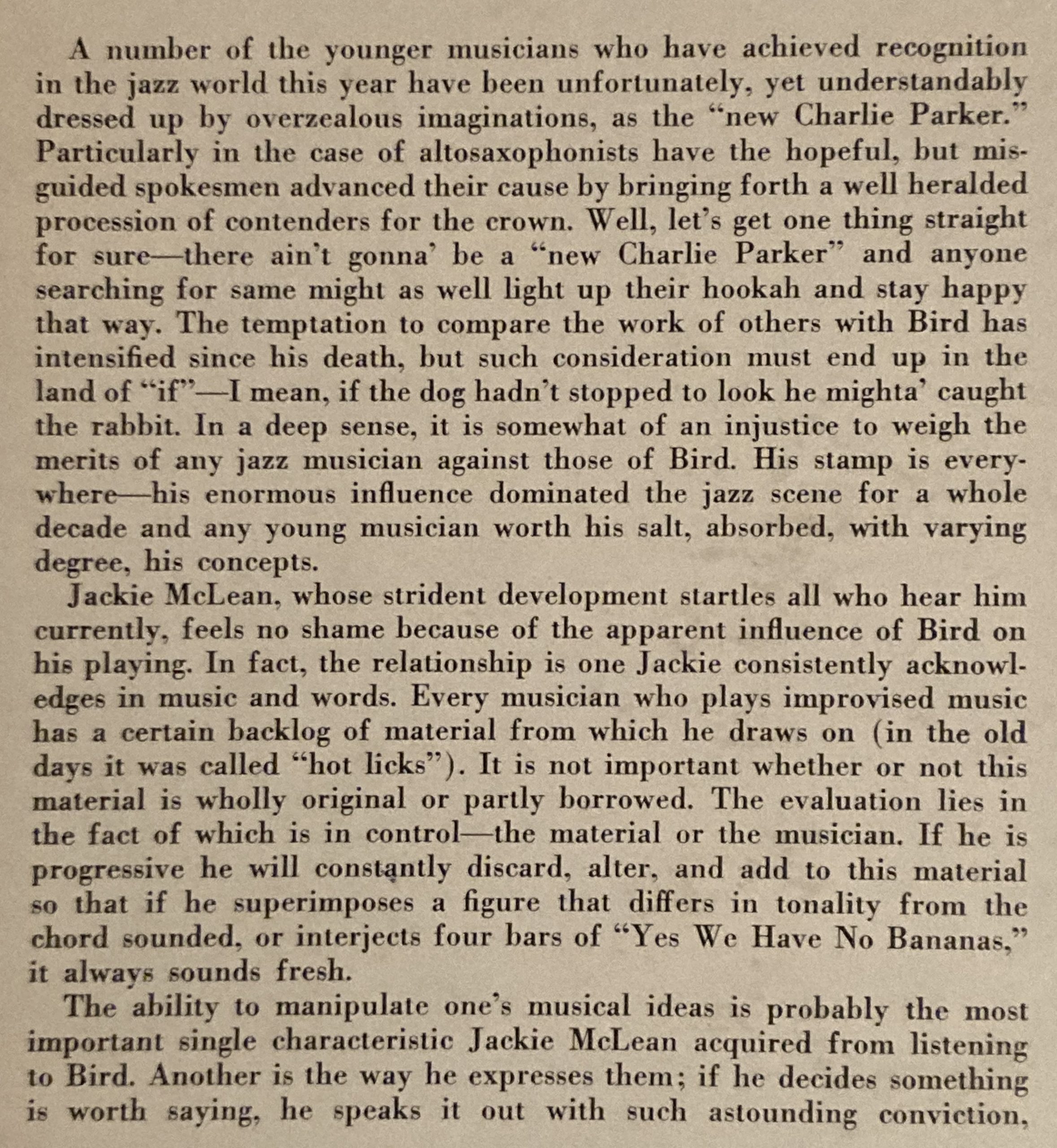
<裏ジャケ原文>
A number of the younger musicians who have achieved recognition in the jazz world this year have been unfortunately, yet understandably dressed up by overzealous imaginations, as the “new Charlie Parker.” Particularly in the case of altosaxophonists have the hopeful, but mis- guided spokesmen advanced their cause by bringing forth a well heralded procession of contenders for the crown. Well, let’s get one thing straight for sure there ain’t gonna’ be a “new Charlie Parker” and anyone searching for same might as well light up their hookah and stay happy that way. The temptation to compare the work of others with Bird has intensified since his death, but such consideration must end up in the land of “if”-I mean, if the dog hadn’t stopped to look he mighta’ caught the rabbit. In a deep sense, it is somewhat of an injustice to weigh the merits of any jazz musician against those of Bird. His stamp is every- where his enormous influence dominated the jazz scene for a whole decade and any young musician worth his salt, absorbed, with varying degree, his concepts.
Jackie McLean, whose strident development startles all who hear him currently, feels no shame because of the apparent influence of Bird on his playing. In fact, the relationship is one Jackie consistently acknowl- edges in music and words. Every musician who plays improvised music has a certain backlog of material from which he draws on (in the old days it was called “hot licks”). It is not important whether or not this material is wholly original or partly borrowed. The evaluation lies in the fact of which is in control-the material or the musician. If he is progressive he will constantly discard, alter, and add to this material so that if he superimposes a figure that differs in tonality from the chord sounded, or interjects four bars of “Yes We Have No Bananas,” it always sounds fresh.
The ability to manipulate one’s musical ideas is probably the most important single characteristic Jackie McLean acquired from listening to Bird. Another is the way he expresses them; if he decides something is worth saying, he speaks it out with such astounding conviction,maturity, and definitiveness, that it seems incongruous with his slight physical appearance and mere 24 years.
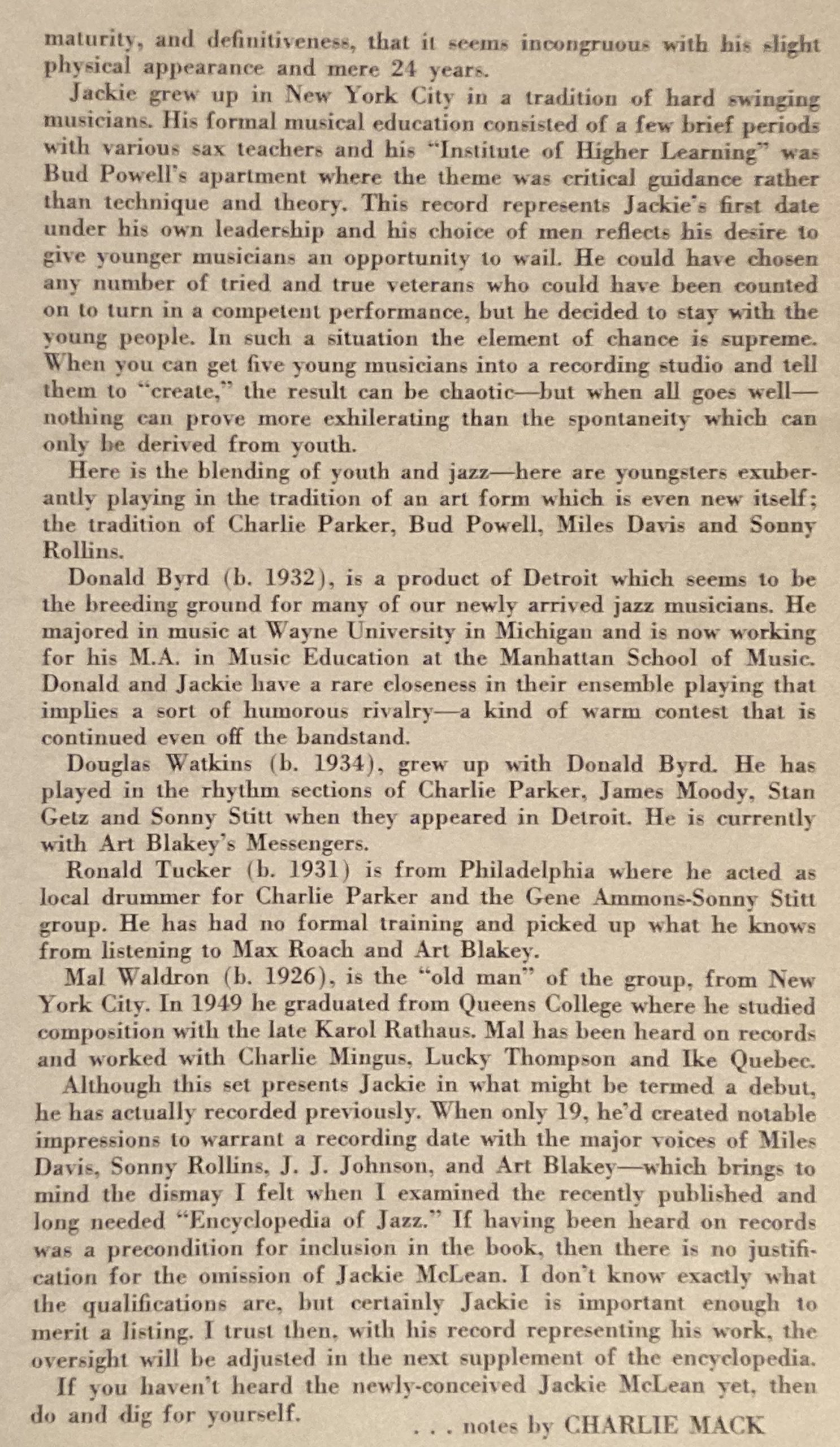
Jackie grew up in New York City in a tradition of hard swinging musicians. His formal musical education consisted of a few brief periods with various sax teachers and his “Institute of Higher Learning” was Bud Powell’s apartment where the theme was critical guidance rather than technique and theory. This record represents Jackie’s first date under his own leadership and his choice of men reflects his desire to give younger musicians an opportunity to wail. He could have chosen any number of tried and true veterans who could have been counted on to turn in a competent performance, but he decided to stay with the young people. In such a situation the element of chance is supreme. When you can get five young musicians into a recording studio and tell them to “create,” the result can be chaotic-but when all goes well- nothing can prove more exhilerating than the spontaneity which can only be derived from youth.
Here is the blending of youth and jazz-here are youngsters exuber- antly playing in the tradition of an art form which is even new itself; the tradition of Charlie Parker, Bud Powell, Miles Davis and Sonny Rollins.
Donald Byrd (b. 1932), is a product of Detroit which seems to be the breeding ground for many of our newly arrived jazz musicians. He majored in music at Wayne University in Michigan and is now working for his M.A. in Music Education at the Manhattan School of Music. Donald and Jackie have a rare closeness in their ensemble playing that implies a sort of humorous rivalry-a kind of warm contest that is continued even off the bandstand.
Douglas Watkins (b. 1934), grew up with Donald Byrd. He has played in the rhythm sections of Charlie Parker, James Moody, Stan Getz and Sonny Stitt when they appeared in Detroit. He is currently with Art Blakey’s Messengers.
Ronald Tucker (b. 1931) is from Philadelphia where he acted as local drummer for Charlie Parker and the Gene Ammons-Sonny Stitt group. He has had no formal training and picked up what he knows from listening to Max Roach and Art Blakey.
Mal Waldron (b. 1926), is the “old man” of the group, from New York City. In 1949 he graduated from Queens College where he studied composition with the late Karol Rathaus. Mal has been heard on records and worked with Charlie Mingus, Lucky Thompson and Ike Quebec. Although this set presents Jackie in what might be termed a debut, he has actually recorded previously. When only 19, he’d created notable impressions to warrant a recording date with the major voices of Miles Davis, Sonny Rollins, J. J. Johnson, and Art Blakey-which brings to mind the dismay I felt when I examined the recently published and long needed “Encyclopedia of Jazz.” If having been heard on records was a precondition for inclusion in the book, then there is no justifi- cation for the omission of Jackie McLean. I don’t know exactly what the qualifications are, but certainly Jackie is important enough to merit a listing. I trust then, with his record representing his work, the oversight will be adjusted in the next supplement of the encyclopedia. If you haven’t heard the newly-conceived Jackie McLean yet, then do and dig for yourself.
.. notes by CHARLIE MACK
<裏ジャケ和訳>
今年ジャズ界で注目を集めた若手ミュージシャンの中には、残念ながら――しかし無理からぬことではあるが――熱狂的な人々の想像力によって「新しいチャーリー・パーカー」のレッテルを貼られてしまった者たちが何人かいる。特にアルトサックス奏者の場合、期待を寄せるものの見当違いな代弁者たちが、その「王座」を継ぐ候補者を次々と大々的に売り出してきた。だが、はっきりさせておこう。「新しいチャーリー・パーカー」などというものは存在しないし、それを探そうとするくらいなら、水タバコでも吸ってのんびりしている方がましというものだ。彼の死後、他者の演奏を「バード(チャーリー・パーカーの愛称)」と比較したくなる誘惑は強まる一方だが、そうした考察は結局のところ「もしも」の世界――「もしあの犬が立ち止まってよそ見をしなければ、ウサギを捕まえられたかもしれないのに」といった類の話――に終わってしまう。根本的な意味で、どんなジャズ・ミュージシャンの価値であれ、それをバードと比較して測ることは、ある種不当なことと言える。彼の刻印は至る所にあり、その絶大な影響力は丸10年にわたってジャズ・シーンを支配し、実力ある若手ミュージシャンなら誰もが、多かれ少なかれ彼の音楽的コンセプトを吸収してきたからだ。
現在、その強烈な進化ぶりで聴く者を驚かせているジャッキー・マクリーンは、自身の演奏にバードの影響が色濃く表れていることを恥じてはいない。それどころか、彼は音楽的にも言葉の上でも、その関係性を一貫して認めている。即興音楽を演奏するミュージシャンは誰しも、引き出しとなる素材の蓄積(かつては「ホット・リックス」などと呼ばれたもの)を持っている。その素材が完全にオリジナルか、あるいは部分的に借用されたものかは重要ではない。重要なのは、素材が主導権を握っているのか、それともミュージシャンが主導権を握っているのか、という点にある。進取の気性に富んだミュージシャンであれば、その素材を絶えず捨て、変え、付け加えていくだろう。そうすれば、鳴っているコードとは調性の異なるフレーズを重ねたり、あるいは「イエス・ウィ・ハヴ・ノー・バナナズ(Yes We Have No Bananas)」の一節を4小節ほど挿入したりしても、常に新鮮な響きが生まれることになる。
自身の音楽的アイデアを自在に操る能力こそ、ジャッキー・マクリーンがバードを聴くことで身につけた最も重要な資質だろう。もう一つの資質は、その表現方法にある。彼は「語るに値する」と判断したことを、驚くほどの確信と成熟、そして断固とした態度で表現する。その姿は、彼の小柄な体格や、まだ24歳という若さとは不釣り合いにさえ思えるほどである。
ジャッキーはニューヨークで、力強くスウィングするミュージシャンたちの伝統の中で育ちました。彼が受けた正式な音楽教育といえば、数人のサックス講師に短期間師事した程度のものでした。彼にとっての「高等教育の場」はバド・パウエルのアパートであり、そこで学んだのは技術や理論よりも、むしろ音楽に対する批評的な指導でした。本作はジャッキーにとって初のリーダー・アルバムであり、彼が共演者に若手を選んだことには、彼らに思い切り演奏する(ウェイルする)機会を与えたいという意図が表れています。手堅い演奏が期待できるベテランを起用することもできたでしょうが、彼はあえて若手と組む道を選びました。こうした状況では、偶然性が大きな要素を占めます。5人の若手ミュージシャンをスタジオに集め、「創造せよ」と促せば、結果は混沌としたものになるかもしれません。しかし、すべてがうまくいったとき、若さゆえの即興性から生まれる高揚感に勝るものはないのです。
ここに、若さとジャズの融合があります。チャーリー・パーカー、バド・パウエル、マイルス・デイヴィス、ソニー・ロリンズといった先人たちの伝統――それ自体まだ新しい芸術形式の伝統――を受け継ぎ、若者たちが情熱的に演奏しているのです。
ドナルド・バード(1932年生まれ)はデトロイト出身です。デトロイトは、近年登場した多くのジャズ・ミュージシャンを輩出している土地と言えるでしょう。彼はミシガン州のウェイン大学で音楽を専攻し、現在はマンハッタン音楽院で音楽教育の修士号取得を目指しています。ドナルドとジャッキーのアンサンブルには、ユーモラスなライバル関係を思わせるような、稀に見る親密さが感じられます。それは、バンドスタンドを降りてからも続く、温かい競い合いのようなものです。
ダグラス・ワトキンス(1934年生まれ)はドナルド・バードと共に育ちました。彼は、チャーリー・パーカー、ジェームス・ムーディ、スタン・ゲッツ、ソニー・スティットらがデトロイトで公演を行う際、そのリズム・セクションを務めた経験があります。現在はアート・ブレイキーの「メッセンジャーズ」に在籍しています。
ロナルド・タッカー(1931年生まれ)はフィラデルフィア出身で、同地ではチャーリー・パーカーやジーン・アモンズ=ソニー・スティット・グループの地元ドラマーとして活動していました。正式な音楽教育は受けておらず、マックス・ローチやアート・ブレイキーの演奏を聴くことで技術を身につけました。
マル・ウォルドロン(1926年生まれ)はニューヨーク出身で、このグループの中では最年長のメンバーです。彼は1949年にクイーンズ・カレッジを卒業し、そこで故カロル・ラトハウスに作曲を師事しました。マル(・ウォルドロン)はこれまでに数々のレコードに参加し、チャーリー・ミンガス、ラッキー・トンプソン、アイク・ケベックらと共演してきました。本作はジャッキーにとって「デビュー作」と呼べるものかもしれませんが、実はそれ以前にも録音経験があります。彼はわずか19歳にして、マイルス・デイヴィス、ソニー・ロリンズ、J.J.ジョンソン、アート・ブレイキーといった巨匠たちとのレコーディングに抜擢されるほど、強い印象を残していました。この事実は、最近出版された待望の『ジャズ百科事典(Encyclopedia of Jazz)』を調べた際に私が抱いた落胆の念を想起させます。もしレコードへの参加が掲載の条件だったとするならば、ジャッキー・マクリーンが除外されていることに正当な理由は見当たりません。掲載基準の詳細は分かりませんが、ジャッキーは間違いなく記載されるに値する重要な人物です。ですから、本作によって彼の業績が示された以上、次回の追補版ではこの見落としが是正されることを期待しています。もし、新たな境地を開拓したジャッキー・マクリーンの演奏をまだ聴いていないなら、ぜひ聴いて、その魅力をあなた自身で確かめてみてください。
……チャーリー・マックによるライナーノーツ
※訳文の制作にはGoogleドライブとGoogle翻訳のお世話になりました。
AD-LIB盤の新星堂からの再発バージョン(本物のネコジャケ)のライナーノーツの文言も同じものでした。


コメント